
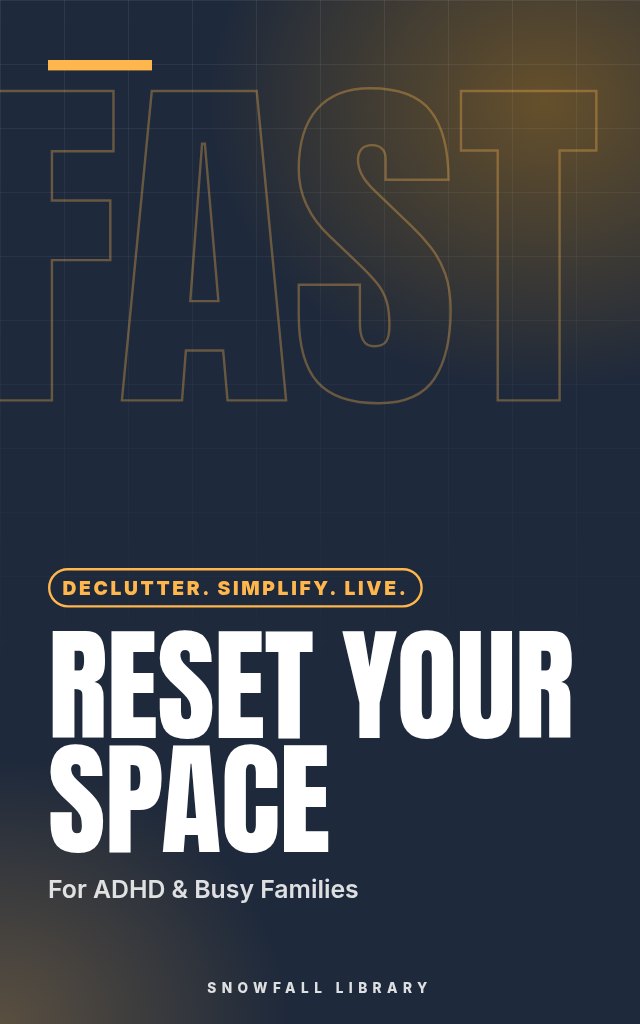
Reset Your Space: Declutter Room by Room, ADHD and Family Friendly
A decision-first way to clear clutter in short bursts and keep a home you can reset in ten minutes.
About this guide
- Overwhelmed adults who don't know where to start
- Busy parents sharing a home with lots of other people's stuff
- People with ADHD who've abandoned decluttering projects halfway
- Anyone getting a home ready to sell
- Stop-anywhere sprint methods for real progress in short bursts
Product details
| Publisher | Snowfall Library (founded by Max) |
|---|---|
| Format | PDF Guide |
| Length | 20+ pages |
| Language | English |
| Delivery | Instant download after payment |
| Reads on | Phone, tablet, Kindle app or computer |
| Category | Home and Organization |
Better together
Add these to your order and save 35% on each one.
Book description
That spare room door stays closed for a reason. You've stood in the doorway more than once, looked at the piles, and quietly shut it again. This is for that moment.
Reset Your Space is built for interrupted time, low energy and easily distracted brains, not for a free weekend and perfect focus. It begins with why possessions carry so much mental weight, then gets you moving with stop-anywhere sprints: short bursts of decluttering you can drop the moment life calls. There's a full section on decluttering with ADHD or any overloaded brain, with design rules and decision shortcuts. Then it goes room by room through the kitchen, closets and daily spaces before tackling the hard categories: the garage, paper, digital files and sentimental items. You'll get real scripts for talking with family about letting things go, ideas for managing kids' belongings, and a plan for getting donations out the door. The last part covers keeping it that way, plus a plan for decluttering before you sell your home.
Who it's for
- Overwhelmed adults who don't know where to start
- Busy parents sharing a home with lots of other people's stuff
- People with ADHD who've abandoned decluttering projects halfway
- Anyone getting a home ready to sell
What you'll walk away with
- Stop-anywhere sprint methods for real progress in short bursts
- ADHD-friendly design rules and decision shortcuts
- Room-by-room plans for the kitchen, closets and everyday spaces
- Approaches for the garage, paper, digital clutter and sentimental items
- Family scripts and a quick reset routine that keeps clutter from creeping back
What's inside
- Why Your Stuff Feels So Heavy
- Getting Started and Going Fast
- Decluttering With ADHD and Any Overloaded Brain
- Room by Room: Kitchen, Closets and Daily Spaces
- The Hard Categories: Garage, Paper, Digital and Sentimental
- Kids, Family and Getting Stuff Out the Door
- Keeping It That Way and Getting Ready to Sell
- Your Toolkit
Look inside
Why Your Stuff Feels So Heavy
You walk in the front door and the first thing you see is the pile. Shoes in a heap, a bag of things that were supposed to go back to the store, mail that has been "sorted" three times without ever leaving the counter. You put your keys down somewhere, and ten minutes later you cannot find them. You are tired before you have even taken your coat off. Maybe you have tried before. You bought the bins, spent a Saturday emptying one closet, and then life happened. The closet filled back up. The bins became part of the clutter. And somewhere along the way a quiet voice started telling you that other people can keep a house in order and you just cannot. That voice is wrong, and this section is about why. Before you touch a single drawer, understand what clutter is, what it costs you, and why the usual advice has not stuck. Once you see the mechanics, the shame starts to lose its grip, and you can work on the real problem instead of on yourself. ### Clutter is not a character flaw. It is a math problem. Every home has two flows: stuff coming in and stuff going out. Groceries, mail, gifts, school papers, online orders, freebies, hand-me-downs, receipts, packaging. That is the inflow. The outflow is trash, recycling, donations, things you sell, things you use up, things you return. When inflow is larger than outflow, clutter grows. It does not matter how organized you are, how many bins you own, or how much you care. If more comes in than goes out, the surplus has to land somewhere, and it lands on flat surfaces, in corners, on chairs, and in the "junk room." Think about how lopsided those flows usually are: | Inflow (happens automatically) | Outflow (requires a decision and an action) | |---|---| | Mail arrives every day | Someone has to open, sort and toss it | | Online orders show up at the door | Someone has to break down boxes and take them out | | Kids bring home art and handouts | Someone has to choose what stays | | Gifts arrive at holidays and birthdays | Someone has to decide to pass things on | | Free samples, swag, party favors | Someone has to say no or throw them away | Notice the pattern. Inflow takes no effort. Outflow takes a decision plus a physical task. That imbalance is the whole story for most homes. You do not have a "messy person" problem. You have a system where stuff enters on autopilot and leaves only by willpower. > Pro tip: Every time you feel the urge to blame yourself, swap the question "What is wrong with me?" for "Where is the inflow beating the outflow?" The second question has an answer you can act on. ### Clutter is a pile of postponed decisions Look at any cluttered spot in your home and ask what each item is waiting for. The jacket on the chair is waiting for you to decide it is worth hanging up or worth giving away. The pile of papers is waiting for you to decide what to keep, what to pay, and what to shred. The box in the hallway is waiting for you to decide whether the thing inside goes back. Clutter is what decisions look like when they have been postponed. Each item silently asks, "What about me?" every time you see it. That is why a cluttered room feels loud even when it is silent. Your brain keeps registering open questions. This reframe matters because it changes what "decluttering" means. You are not cleaning. You are making decisions, and decisions are tiring. That explains three things you may have noticed: 1. You run out of steam fast. Decision fatigue is real in everyday experience. After an hour of "keep ...
Readers also browse

Check Texts, Emails, Jobs and Stores Before You Pay

Identify, Cancel and Recover Payments You Didn't Expect

Start a Business With No Idea and No Money

A 30-Day Reset for Phone Habits and Focus