
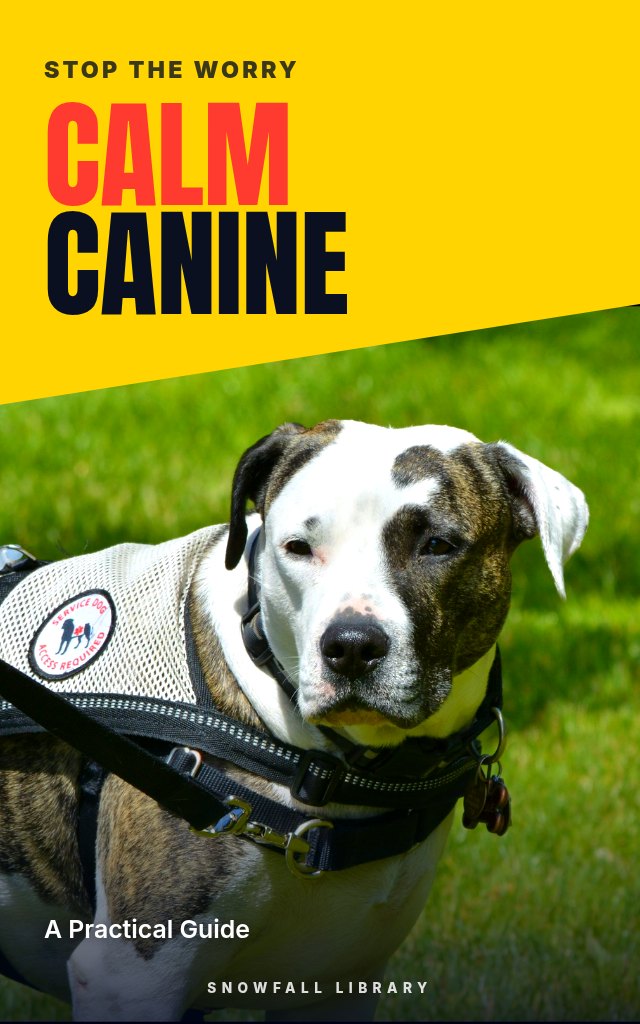
Calm Canine: Help Your Anxious Dog Feel Safe, One Step at a Time
Pinpoint exactly what scares your dog, then work through a desensitization plan that moves at their pace.
About this guide
- First-time dog owners caught off guard by fear or reactivity
- Rescue dog families working with an unknown past
- Owners who've noticed a sudden change in their dog's behavior
- Anyone who's tried basic training and needs more
- The ability to read subtle signs of anxiety and tell normal fear from something more serious
Product details
| Publisher | Snowfall Library (founded by Max) |
|---|---|
| Format | PDF Guide |
| Length | 20+ pages |
| Language | English |
| Delivery | Instant download after payment |
| Reads on | Phone, tablet, Kindle app or computer |
| Category | Pets |
Better together
Add these to your order and save 35% on each one.
Book description
Keys in hand, you hear the pacing start. By the time you reach the door, your dog is panting and pressed against your legs, and you've half decided not to go out at all.
Calm Canine moves past broad labels like 'separation anxiety' to the specific things that frighten your dog. Once you know the triggers, the Calm Canine Protocol walks you through desensitization and counter-conditioning with a custom training schedule, progress tracking and help when things stall. Diet, exercise, enrichment and calming signals support the training, and there's honest guidance on when to bring in a veterinary behaviorist or certified trainer.
Who it's for
- First-time dog owners caught off guard by fear or reactivity
- Rescue dog families working with an unknown past
- Owners who've noticed a sudden change in their dog's behavior
- Anyone who's tried basic training and needs more
What you'll walk away with
- The ability to read subtle signs of anxiety and tell normal fear from something more serious
- Assessment checklists that pinpoint your dog's specific triggers
- A desensitization and counter-conditioning plan with a schedule, tracking and troubleshooting
- Practical support through diet, exercise, enrichment and positive reinforcement
- Clear signs for when to seek professional help, and strategies to keep anxiety from returning
Calmer walks start with knowing what your dog is afraid of.
What's inside
- Part 1: Understanding Dog Anxiety
- Part 2: Diagnosis & Assessment
- Part 3: The Calm Canine Protocol - A Step-by-Step System
- Part 4: Holistic Support
- Part 5: When to Seek Professional Help
- Part 6: Maintaining Calm & Preventing Relapse
Look inside
Part 1: Understanding Dog Anxiety
You're likely here because your dog is showing behaviors that are concerning you. Perhaps it’s excessive barking, destructive chewing when left alone, trembling during car rides, or a general reluctance to engage with the world. These aren’t just “bad habits”; they’re signs your dog is struggling with fear, stress, or anxiety. It’s incredibly frustrating to watch your companion suffer, and even more so when you feel helpless to fix it. This book is designed to move you from feeling helpless to feeling empowered, with a clear understanding of what's happening and, more importantly, practical tools to help your dog.
Understanding the Core Concepts
Before we can tackle solutions, we need a common language. Many people use the terms “fear,” “stress,” and “anxiety” interchangeably, but they represent different states, each with distinct physiological and behavioral expressions. Understanding these differences is the first step toward effective intervention.
- Fear is an immediate, instinctive reaction to a perceived threat. It's a short-lived, survival mechanism triggered by something directly present. For example, a dog seeing a snake will likely exhibit fear, a rapid retreat, barking, or even aggression. The threat is now.
- Stress is the body’s response to a demand or challenge. Unlike fear, stress can be caused by both physical and psychological stressors. A short-lived stress response is normal and even healthy, allowing a dog to cope with novel situations. Think of a dog briefly startled by a loud noise but quickly recovering. However, prolonged or chronic stress is damaging.
- Anxiety is a future-oriented emotional state characterized by anticipation of threat, uncertainty, and apprehension. It’s not a reaction to something currently happening, but a worry about something that might happen. A dog with separation anxiety isn't afraid of you leaving right now; they’re afraid of being left alone later.
The Body’s Response: The Four F’s
When a dog perceives a threat (whether real or imagined), their body activates the “fight, flight, freeze, or fawn” response, a deeply ingrained survival mechanism. Understanding these responses helps you interpret your dog’s behavior.
- Fight: This involves aggression, barking, growling, snapping, or biting, aimed at eliminating the perceived threat.
- Flight: This is escape behavior, running away, hiding, or trying to avoid the source of fear.
- Freeze: This involves becoming immobile, hoping the threat will pass unnoticed. A frozen dog may appear stiff, with wide eyes and a tucked tail.
- Fawn: Less commonly discussed, this involves attempting to appease the perceived threat through submissive behaviors like licking, rolling onto their back, or excessive tail wagging (which isn’t necessarily a sign of happiness in this context).
Example: Imagine a dog at the vet. If the dog growls at the vet technician approaching with a needle, that’s fight. If the dog tries to bolt out the door, that’s flight. If the dog becomes completely still and stares blankly ahead, that’s freeze. If the dog licks the vet tech's hand while visibly trembling, that's fawn.
Physiological Changes: What’s Happening Inside
These behavioral responses are driven by significant physiological changes:
| System | Response | Manifestation in Dogs |
|---|---|---|
| Nervous System | Increased activity | Dilated pupils, rapid heartbeat, panting |
| Endocrine System | Release of cortisol & adrenaline | Increased energy, suppressed immune system |
| Digestive System | Slowed or disrupted | Diarrhea, vomiting, loss of appetite |
| Musculoskeletal | Muscle tension | Trembling, shaking, stiff posture |
These changes aren't just emotional; they’re physical. Chronic activation of this stress response can lead to long-term health problems.
Normal vs. Pathological Anxiety: When is it a Problem?
A certain level of fear and stress is normal and even beneficial for dogs. It keeps them safe. A dog briefly startled by a loud noise, cautious around unfamiliar dogs, or mildly anxious during a thunderstorm is exhibiting normal behavior.
Pathological anxiety, however, is excessive, persistent, and interferes with a dog’s ability to function normally. It's ...
Readers also browse

Check Texts, Emails, Jobs and Stores Before You Pay

Identify, Cancel and Recover Payments You Didn't Expect

Start a Business With No Idea and No Money

A 30-Day Reset for Phone Habits and Focus