
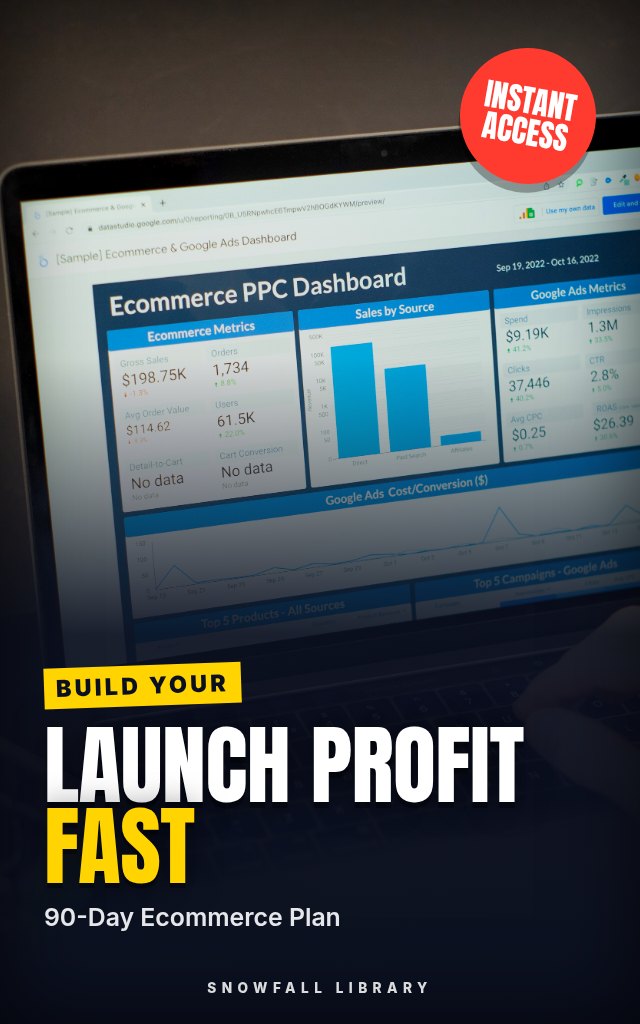
Ecommerce Blueprint: From Idea to Launch in 90 Days
From Idea to Profitable Online Business in 90 Days
About this guide
- Entrepreneurs with a product idea and a desire to build an online business.
- Side hustlers seeking a flexible income stream.
- Small business owners wanting to expand into online sales.
- Anyone tired of endless research and ready for action.
- A validated product idea and a clear understanding of your ideal customer.
Product details
| Publisher | Snowfall Library (founded by Max) |
|---|---|
| Format | PDF Guide |
| Length | 20+ pages |
| Language | English |
| Delivery | Instant download after payment |
| Reads on | Phone, tablet, Kindle app or computer |
| Category | Small Business & Ecommerce |
Better together
Add these to your order and save 35% on each one.
Book description
Is a great product idea stuck on your to-do list? Too many entrepreneurs spend months planning, then get discouraged before they actually launch. This guide helps you cut through the overwhelm and build something real.
Who it's for
- Entrepreneurs with a product idea and a desire to build an online business.
- Side hustlers seeking a flexible income stream.
- Small business owners wanting to expand into online sales.
- Anyone tired of endless research and ready for action.
What you'll walk away with
- A validated product idea and a clear understanding of your ideal customer.
- A realistic financial plan to maximize profit and manage cash flow.
- A streamlined process for sourcing products and handling fulfillment.
- A targeted marketing strategy to attract and convert buyers.
- The tools to analyze results and scale your business for long-term growth.
What's inside
- Part 1: Laying the Foundation - Niche & Validation
- Part 2: Financial Blueprint - Planning for Profitability
- Part 3: Sourcing & Operations - Building Your Supply Chain
- Part 4: Marketing & Sales - Attracting & Converting Customers
- Part 5: Optimization & Growth - Scaling for Long-Term Success
Look inside
Part 1: Laying the Foundation - Niche & Validation
The Ecommerce Landscape & Avoiding Common Pitfalls
You’re here because you have a product idea, or maybe just the itch to build something online. You see others succeeding with ecommerce and think, “I can do that.” That’s good. But let's be honest: the internet is full of abandoned online stores. Many start with enthusiasm, then stall out. This section will give you a grounded view of the current landscape and, more importantly, show you how to avoid becoming another statistic. We'll focus on practical steps you can take today to increase your chances of success.
The Current State of Play
Ecommerce isn’t just “hot” anymore; it's established. Growth isn't the explosive rate of 2020-2022, but it’s still healthy and consistent. Consumers are comfortable buying online, and that habit isn’t going away. Competition is fierce, however. Success requires more than just a website and a product. It demands strategic thinking, consistent effort, and a willingness to adapt.
The biggest shifts right now are towards mobile commerce (over 60% of ecommerce sales happen on mobile devices), social commerce (buying directly through platforms like Instagram and TikTok), and a greater emphasis on personalized experiences. Consumers expect convenience, value, and brands that align with their values.
Common Ecommerce Mistakes
Before we jump into opportunities, let’s look at what doesn’t work. Understanding these pitfalls is crucial.
- Lack of Validation: Building a product no one wants is the quickest path to failure. Too many entrepreneurs fall in love with their idea without confirming there’s actual demand.
- Poor Niche Selection: Trying to compete in overly broad markets (like “clothing” or “electronics”) is a recipe for getting lost in the noise.
- Ignoring Unit Economics: Selling products at a loss, or with razor-thin margins, will quickly drain your resources.
- Insufficient Marketing: “If you build it, they will come” is a myth. You must actively drive traffic to your store.
- Operational Inefficiency: Slow shipping, inaccurate orders, and poor customer service will kill your reputation.
- Giving Up Too Soon: Ecommerce takes time and effort. Expect setbacks and be prepared to persevere.
Ecommerce Business Models: Pros & Cons
Let's break down the most common ways to sell online. Each has its advantages and disadvantages.
Ecommerce Business Model Comparison Chart
| Model | Startup Cost | Inventory Risk | Profit Margin | Complexity | Scalability |
|---|---|---|---|---|---|
| Dropshipping | Low ($100+) | Very Low | Low-Medium | Low | High |
| Wholesale | Medium ($500+) | Medium-High | Medium | Medium | Medium |
| Private Label | Medium-High ($1000+) | Medium-High | Medium-High | Medium-High | Medium |
| Subscription Box | High ($2000+) | Medium-High | Medium-High | High | Medium |
- Dropshipping: You sell products without holding any inventory. When a customer orders, you forward the order to a third-party supplier who ships it directly. Pros: Low startup costs, minimal risk. Cons: Low profit margins, reliance on supplier quality, limited branding control.
- Wholesale: You purchase products in bulk from manufacturers or distributors and resell them at a higher price. Pros: Better profit margins than dropshipping, more control over inventory. Cons: Requires upfront investment in inventory, storage space needed.
- Private Label: You source products from a manufacturer and sell them under your own brand. Pros: High profit margins, strong branding potential, product differentiation. Cons: Significant upfront investment, more complex supply chain.
- Subscription Box: You curate a selection of products and ship them to customers on a recurring basis. Pros: Recurring revenue, strong customer loyalty. Cons: High startup costs, complex logistics, requires consistent content creation.
Action step: Download the Ecommerce Business Model Comparison Chart and honestly assess which model best fits your resources, risk tolerance, and long-term goals.
A Real-World Failure: "Trendy Gadgets"
Let’s look at a hypothetical example of an ecommerce store that failed. “Trendy Gadgets” launched in early 2023, selling various novelty tech accessories. They ...
Readers also browse
Start a Business With No Idea and No Money
Sell Handmade Goods and Digital Downloads With Confidence

Land Your First Freelance Clients With Zero Experience

Sell Knowledge