
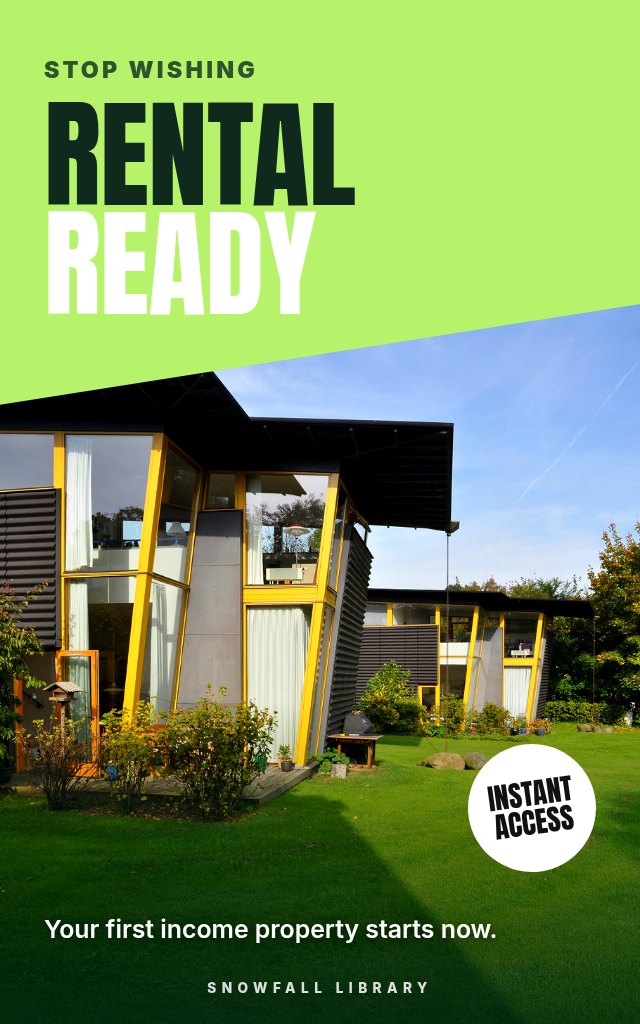
First Rental: Cashflow Keys
Buy your first income property, even with a small down payment
About this guide
- Working professionals in their 20s to 40s, serious about building wealth through real estate.
- Those who think a large down payment is the only way to begin.
- Investors seeking a practical, numbers-focused approach to evaluating properties.
- Anyone wanting clear, honest advice on financing options beyond traditional mortgages.
- A firm grasp of the 1% rule and cash-on-cash return, illustrated with realistic examples.
Product details
| Publisher | Snowfall Library (founded by Max) |
|---|---|
| Format | PDF Guide |
| Length | 20+ pages |
| Language | English |
| Delivery | Instant download after payment |
| Reads on | Phone, tablet, Kindle app or computer |
| Category | real estate investing basics |
Better together
Add these to your order and save 35% on each one.
Book description
Want to earn passive income through real estate but feel stuck in endless research? You’re not alone. Many dream of rental properties, but hesitate before taking the first step.
Who it's for
- Working professionals in their 20s to 40s, serious about building wealth through real estate.
- Those who think a large down payment is the only way to begin.
- Investors seeking a practical, numbers-focused approach to evaluating properties.
- Anyone wanting clear, honest advice on financing options beyond traditional mortgages.
What you’ll walk away with
- A firm grasp of the 1% rule and cash-on-cash return, illustrated with realistic examples.
- The ability to analyze properties quickly and accurately using a downloadable spreadsheet and inspection checklist.
- Effective conversation starters for lenders, agents, and sellers to help you secure the best deal.
- A clear breakdown of financing options, FHA, VA, 401k, and LLCs, with honest pros and cons.
- Practical strategies for managing your first 90 days as a landlord and avoiding common pitfalls.
What's inside
- Part 1: Readiness & Money - Laying the Foundation
- Financing Options: Low and No-Money-Down Strategies
- Part 2: Finding & Analyzing Deals - The Deal Pipeline
- Part 3: Buying the Property - From Offer to Closing
- Part 4: First 90 Days as a Landlord - Managing Your Investment
Look inside
Part 1: Readiness & Money - Laying the Foundation
You already know the script. It's 11:47 on a Tuesday night, you're three tabs deep into a Reddit thread about a guy who bought a duplex with $12,000, and you're doing mental math on your savings account for the fourth time this month. Tomorrow you'll close the tabs, tell yourself you'll get serious once you have more saved, and nothing will change.
This book exists because that loop has a cost, and it's bigger than you think. Not a vague motivational cost. An actual number you can calculate. So let's calculate it, then let's dismantle the two beliefs that keep you in that loop: that you need $50,000 or more to start, and that waiting is the safe option.
The Math of Waiting One More Year
Here's a concrete scenario. You buy a $200,000 duplex using an FHA owner-occupied loan at 3.5% down. That's $7,000 down, roughly $6,000 in closing costs, call it $13,000 to $14,000 all in. You live in one unit, rent the other for $1,100 a month. We'll dig into this exact strategy in Chapter 2, but for now, just follow the numbers.
Now watch what that property does over five years with conservative assumptions: 3% annual appreciation, rents growing 2% a year, and a 30-year fixed mortgage.
| Year | Property Value | Loan Balance | Your Equity | Rent Collected (other unit) |
|---|---|---|---|---|
| 0 | $200,000 | $193,000 | $7,000 | $0 |
| 1 | $206,000 | $189,600 | $16,400 | $13,200 |
| 3 | $218,500 | $182,300 | $36,200 | $40,400 |
| 5 | $231,900 | $174,400 | $57,500 | $68,900 |
Five years in, you've built roughly $57,000 in equity from a $13,000 investment, while a tenant paid down your loan and covered most of your housing cost. The renter version of you, saving $500 a month into a high-yield account, has about $31,000 after five years. The difference isn't small. It's the price of five years of "I'll do it when I'm ready."
And that table ignores the two quieter wealth builders: principal paydown (your tenant is buying you the house, roughly $18,600 of that equity is just loan amortization) and depreciation, which shelters much of your rental income from taxes.
Action step: Pull up a mortgage calculator right now. Enter a $200,000 purchase price, 3.5% down, a current 30-year rate, and 30 years. Look at the amortization schedule and find how much principal is paid off by year five. That number is what your future tenant hands you. Write it down.
Why Leverage Changes Everything
Leverage is the reason real estate builds wealth faster than your index fund for people starting with modest money. Here's the why in one sentence: you control a $200,000 asset with $13,000, but you capture appreciation on the full $200,000.
If that property appreciates 3% in year one, it gains $6,000 in value. On your $13,000 invested, that's a 46% return before counting rent or principal paydown. Your stock portfolio doesn't let you do this. Nobody will lend you $193,000 to buy index funds, because stocks can gap down 30% in a quarter. Houses, boringly and beautifully, tend not to. Banks know this, which is why they'll lend you 96.5% of a home's value at a fixed rate for 30 years. That loan product is a gift, and most people leave it unopened for a decade.
Leverage cuts both ways, of course. If the property drops 10%, you've lost more than your down payment on paper. The defense against that is simple: buy for cash flow, not appreciation. If the rent covers the mortgage and expenses every month, a paper loss doesn't force you to sell. You just keep collecting rent and wait. We'll build that cash flow analysis skill in Chapter 3, because it's the single most important thing in this book.
Myth 1: "I Need ...
Readers also browse

Check Texts, Emails, Jobs and Stores Before You Pay

Identify, Cancel and Recover Payments You Didn't Expect
A 90-Day Plan to Stop Living Paycheck to Paycheck

A Calm, Long-Term Start in the Stock Market