
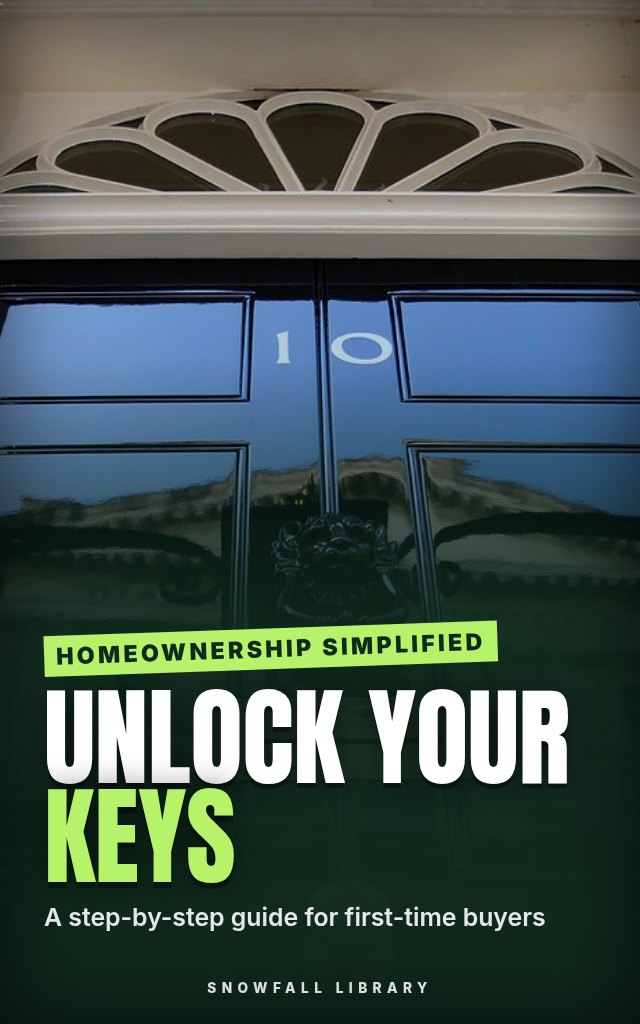
Get Your Keys: Loans, Assistance Programs and Every Step to Closing
Worksheets, scripts and plain-English explanations that take first-time buyers from renting to closing day.
About this guide
- Renters in their late 20s to 40s ready to buy a first home
- Anyone confused by mortgages, down payments and closing costs
- First-time buyers worried about making an expensive mistake
- People who suspect they might qualify for down payment help but don't know where to look
- A readiness worksheet and a realistic figure for what you can afford
Product details
| Publisher | Snowfall Library (founded by Max) |
|---|---|
| Format | PDF Guide |
| Length | 20+ pages |
| Language | English |
| Delivery | Instant download after payment |
| Reads on | Phone, tablet, Kindle app or computer |
| Category | Personal Finance and Real Estate |
Better together
Add these to your order and save 35% on each one.
Book description
Months of refreshing listings, and you know roughly what you want. But every time you look into mortgages, you hit a wall of acronyms, closing costs and the quiet fear of signing something you'll regret for thirty years.
This guide lays the whole purchase out in order, from getting your money ready to your first year as an owner. It explains the main loan types (FHA, conventional, VA and USDA) in plain English. Instead of handing you a list of assistance programs that goes out of date, it shows you how to find and judge your own state's programs at the official source. Worksheets, lender scripts and checklists come with each stage.
Who it's for
- Renters in their late 20s to 40s ready to buy a first home
- Anyone confused by mortgages, down payments and closing costs
- First-time buyers worried about making an expensive mistake
- People who suspect they might qualify for down payment help but don't know where to look
What you'll walk away with
- A readiness worksheet and a realistic figure for what you can afford
- A plain-English understanding of FHA, conventional, VA and USDA loans
- A method for finding first-time buyer programs and down payment assistance in your state
- Preapproval scripts and a checklist for building your team, from agent to inspector
- Guidance on house hunting without regret, offers, contingencies, closing day and the first year
The keys come at the end. This covers everything before them.
What's inside
- Are You Ready? Getting Your Money in Shape
- Mortgage Loans in Plain English
- First Time Home Buyer Programs and Down Payment Assistance
- Preapproval and Building Your Team
- House Hunting Without Regret
- From Offer to Clear to Close
- Closing Day and Your First Year as a Homeowner
- Your Toolkit
Look inside
Are You Ready? Getting Your Money in Shape
You pay rent every month and part of you wonders whether that money is simply disappearing. Friends post photos holding keys in front of a front door. Your parents ask when you are going to "stop throwing money away." Meanwhile you open a mortgage calculator, type in a price, and the number it spits out either looks too good to be true or makes your stomach drop. You are not sure which number to believe, and you are afraid that one wrong move could cost you tens of thousands of dollars. That fear is reasonable. A home is usually the largest purchase most people ever make, and the costs are spread across dozens of line items that nobody explains in one place. This section lays them all out so you can compare renting and owning honestly, using your own numbers instead of slogans. ### Why "renting is throwing money away" is only half true Rent buys you something real: a place to live, with someone else responsible for the roof, the water heater, and the property tax bill. When you own, a large part of your monthly payment in the early years also "disappears," just to different people. Here is where an owner's money goes each month: - Interest goes to the lender. In the first years of a 30-year mortgage, most of each payment is interest. - Property taxes go to your local government. - Homeowners insurance goes to the insurer. - Mortgage insurance (if your down payment is small) goes to protect the lender, not you. - HOA dues (if any) go to the association. - Maintenance and repairs go to plumbers, roofers, and hardware stores. Only the principal portion of your payment builds equity directly. Equity also grows if the home's value rises, but prices can stay flat or fall for years in some markets, so you should never count on appreciation to make a purchase work. So the honest comparison is not "rent versus a mortgage payment." It is "rent versus the unrecoverable costs of owning," which are interest, taxes, insurance, mortgage insurance, HOA dues, maintenance, and the cost of buying and eventually selling. Ownership tends to win when you stay long enough for equity growth to outrun those costs. Renting tends to win when you might move soon or when local prices are very high compared to rents. ### The full monthly cost of owning: PITI plus the extras Lenders talk about PITI: principal, interest, taxes, and insurance. That is the number they use to decide what you qualify for. Your real monthly cost is larger. Use this structure for every home you consider: | Cost | What it is | Where to find the number | |---|---|---| | Principal and interest | The loan payment itself | Lender quote or mortgage calculator | | Property taxes | Annual tax divided by 12 | County assessor or tax collector website, or the listing | | Homeowners insurance | Annual premium divided by 12 | A quote from an insurance agent | | Mortgage insurance | PMI or FHA mortgage insurance | Lender quote | | HOA or condo dues | Monthly association fee | Listing or HOA documents | | Flood or other special insurance | Required in some areas | Insurance agent, flood zone lookup | | Maintenance reserve | Money set aside for repairs | Your own savings plan | | Utilities increase | Owners often pay water, trash, sewer that landlords covered | Ask the seller for past bills | The last two rows never appear on a lender's worksheet, which is exactly why first time buyers get surprised. > Example: Maya rents a two-bedroom apartment for $1,750 a month, and her landlord pays water and trash. She looks at a $300,000 townhouse. Her lender's illustrative quote shows principal and interest of $1,800, property taxes of $350, insurance of $120, and PMI ...
Readers also browse

Check Texts, Emails, Jobs and Stores Before You Pay

Identify, Cancel and Recover Payments You Didn't Expect

Start a Business With No Idea and No Money

A 30-Day Reset for Phone Habits and Focus