
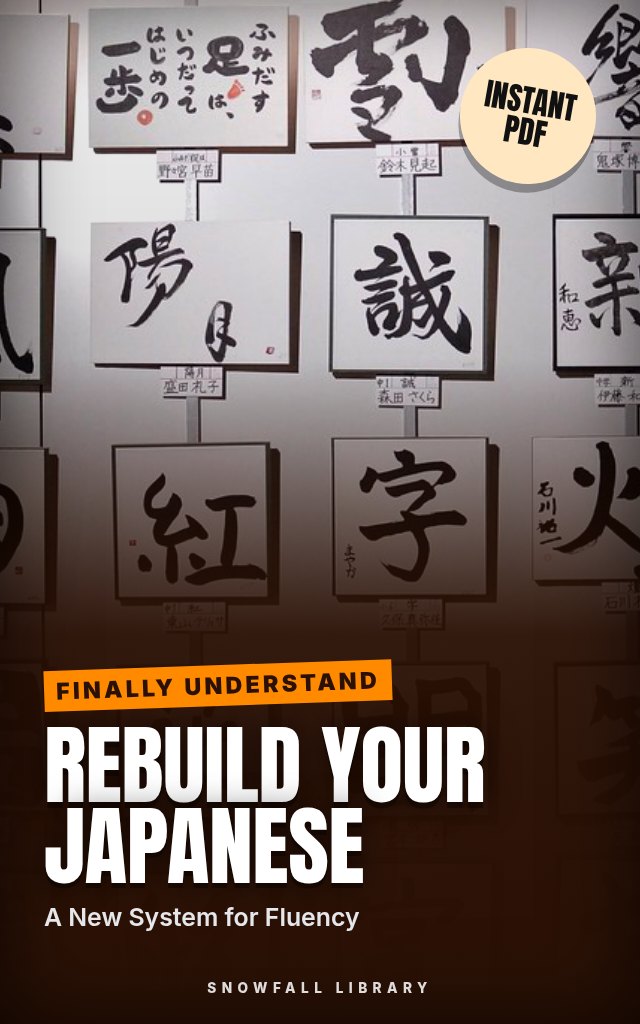
Learn Japanese: New Approach
Build Fluency by Understanding How Language Sticks
About this guide
- Adults who’ve attempted Japanese and want to overcome frustration.
- Learners curious about the science behind effective language learning.
- Anyone seeking a system, not just a collection of resources.
- Those who want to move beyond rote memorization toward confident communication.
- A clear understanding of the common pitfalls in Japanese language study.
Product details
| Publisher | Snowfall Library (founded by Max) |
|---|---|
| Format | PDF Guide |
| Length | 20+ pages |
| Language | English |
| Delivery | Instant download after payment |
| Reads on | Phone, tablet, Kindle app or computer |
| Category | Language Learning |
Better together
Add these to your order and save 35% on each one.
Book description
Struggling to make progress with Japanese? You’re not alone. Many learners cycle through textbooks and apps without seeing real improvement.
Who it's for
- Adults who’ve attempted Japanese and want to overcome frustration.
- Learners curious about the science behind effective language learning.
- Anyone seeking a system, not just a collection of resources.
- Those who want to move beyond rote memorization toward confident communication.
What you'll walk away with
- A clear understanding of the common pitfalls in Japanese language study.
- Strategies for building a strong foundation specifically for the challenges of Japanese.
- Techniques for creating an immersive learning experience, wherever you are.
- Methods for retaining key Japanese elements through active recall and spaced repetition.
- A practical framework for applying your knowledge and achieving fluency.
What's inside
- Understanding the Japanese Learning Trap: The Illusion of Progress
- Phase 1: Foundations - Building the Learning Infrastructure
- Phase 2: Immersion - Creating a Rich Learning Environment
- Phase 3: Active Recall & Spaced Repetition, Mastering the Japanese Building Blocks
- Phase 4: Application - Bringing It All Together
Look inside
Understanding the Japanese Learning Trap: The Illusion of Progress
Understanding the Japanese Learning Trap: The Illusion of Progress
Let’s be honest. You’ve likely been here before. You spent hours with textbooks, flashcards overflowing with vocabulary, maybe even a formal course or two. You could even hold a basic conversation. Then… you stalled. Progress slowed to a crawl. You feel like you’re running harder just to stay in the same place. This isn’t a lack of dedication or intelligence. It’s a predictable consequence of how most people approach learning Japanese, and a fundamental misunderstanding of how your brain actually learns. This section will explain why that happens, and how to break free.
The Plateau Effect: Why Progress Feels Like It Stops
The “plateau effect” is common in any skill acquisition, but it feels particularly frustrating in language learning. You see initial, rapid gains, mastering hiragana and katakana, learning basic greetings. This feels good. It's easy. But that early progress relied on learning completely new information. As you advance, you're no longer just adding new pieces; you’re building connections between things you already (sort of) know, refining existing knowledge, and tackling increasingly nuanced concepts. This requires more effort for smaller gains, creating the sensation of hitting a wall.
Think of it like building a house. The foundation goes down quickly. Framing the walls is relatively fast. But the intricate electrical work, plumbing, and finishing touches? Those take significantly longer, even though they’re essential to a functional home. Japanese learning is the same.
Action step: Before continuing, take a moment to pinpoint where you stalled in your Japanese studies. Be specific. Was it kanji? Particles? Conversational fluency? Identifying this will help you tailor the strategies in this book.
Cognitive Load: Your Brain’s Limited Capacity
The plateau isn't just about increased difficulty; it’s also about your brain’s processing limits. Your brain has a finite amount of “working memory”, the space where it actively processes information. It’s often described as being able to hold roughly 7, plus or minus 2, "chunks" of information at a time.
What constitutes a “chunk” is key. For a beginner, each individual Japanese character is a separate chunk. A simple phrase like “こんにちは” (konnichiwa) requires remembering three separate characters and their pronunciation. For a native English speaker, that’s already pushing the limits of working memory, leaving little room for understanding the meaning of the phrase.
Traditional learning methods, rote memorization of vocabulary lists, endless grammar drills, overload working memory. You’re trying to cram too much information in at once, without sufficient time for it to move into long-term memory. The result? You can recognize the word on a flashcard, but struggle to recall it in a conversation, or even a few minutes later.
Example: Imagine trying to learn a complex recipe by memorizing the entire ingredient list and all the instructions at once. You’ll likely forget something. Instead, you break it down into manageable steps: first gather the ingredients, then chop the vegetables, then… This is how effective learning works.
Recognizing the Symptoms of Cognitive Overload
How do you know if you’re experiencing cognitive overload? Look for these signs:
- Difficulty concentrating: Your mind wanders easily.
- Feeling overwhelmed: You feel stressed or anxious when studying.
- Poor retention: You forget things quickly.
- Slowed processing: It takes longer to understand new information.
- Increased errors: You make more mistakes than usual.
If you recognize these symptoms, you need to reduce the cognitive load.
Reducing Cognitive Load: Practical Strategies
Here’s how to lighten the burden on your working memory:
- Break Down Information: Instead of trying to learn ten new kanji at once, start with two or three. Focus on understanding their meaning, radicals, and how they’re used in context. 2. Chunking: Combine smaller pieces of information into larger, meaningful units. For example, instead of memorizing individual vocabulary words, learn phrases or sentences. 3. Spaced Repetition (We’ll cover this in detail later): Review information ...
Readers also browse

Reclaim Your Time, Reduce Stress, and Get More Done
An Evidence-Based Study System for High-Stakes Exams

A System for Sustainable Attention & Deep Work
Brain Boost