
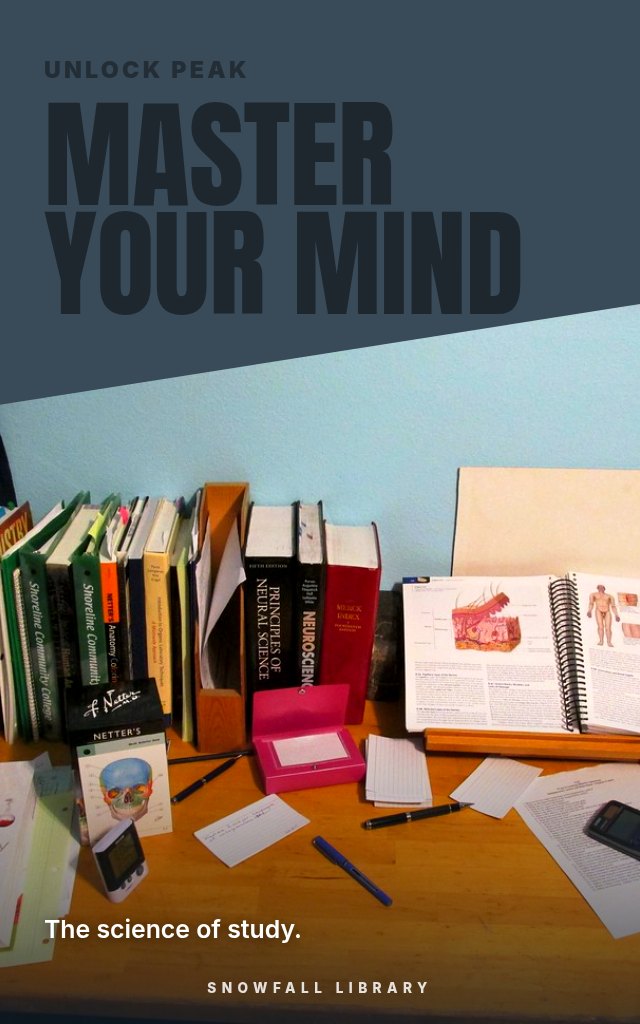
Train Your Mind: An Evidence-Based Study System for High-Stakes Exams
Active recall, spaced repetition and a focus protocol built for the way your brain actually works.
About this guide
- College, nursing and medical students facing exams with heavy, unforgiving workloads
- Students with ADHD or executive dysfunction who struggle to start, stay on task, or stop losing whole evenings to avoidance
- Anyone who studies for hours and still blanks on the questions
- Learners who've burned out once and don't want a repeat
- A clear diagnosis of where your memory and focus break down, using the basics of cognitive load and retrieval
Product details
| Publisher | Snowfall Library (founded by Max) |
|---|---|
| Format | PDF Guide |
| Length | 20+ pages |
| Language | English |
| Delivery | Instant download after payment |
| Reads on | Phone, tablet, Kindle app or computer |
| Category | Study Skills |
Better together
Add these to your order and save 35% on each one.
Book description
It's eleven at night, the highlighter is running dry, and you've read the same page three times. Nothing has gone in. The exam is nine days away and the syllabus hasn't shrunk.
Most study advice tells you to work harder. This system starts with why your memory is dropping things in the first place (cognitive load and weak retrieval), then swaps rereading and highlighting for methods that make information stay put. There's a dedicated protocol for ADHD and executive dysfunction, because getting started is often the hardest part.
Who it's for
- College, nursing and medical students facing exams with heavy, unforgiving workloads
- Students with ADHD or executive dysfunction who struggle to start, stay on task, or stop losing whole evenings to avoidance
- Anyone who studies for hours and still blanks on the questions
- Learners who've burned out once and don't want a repeat
What you'll walk away with
- A clear diagnosis of where your memory and focus break down, using the basics of cognitive load and retrieval
- Six high-yield note-taking frameworks, so you can match the method to the subject
- Ready-made workflows for active recall and spaced repetition that replace passive review
- A neurodivergent focus protocol for task initiation, sustained attention and the emotional side of studying
- An exam playbook with dynamic schedules that adjust when the week goes sideways
Less rereading. More remembering.
What's inside
- The Diagnostics of Cognitive Load & Memory Retrieval
- The 6 High-Yield Note-Taking Frameworks
- Active Recall & Spaced Repetition Workflows
- The Neurodivergent Focus Protocol (ADHD & Executive Dysfunction)
- The High-Stakes Exam Playbook & Dynamic Schedules
Look inside
The Diagnostics of Cognitive Load & Memory Retrieval
You are currently trapped in the most dangerous cycle in higher education. It is the cycle of passive consumption. You attend lectures. You highlight textbooks. You rewrite your notes until they look like a work of art. You read your slides until the words feel familiar. You feel like you are working hard. You feel like you understand the material. You tell yourself that if you just put in enough hours, the information will stick.
Then, you sit down for the exam. The professor asks a question that requires you to synthesize the information. You stare at the paper. You know you have seen the answer before. You know it is in your notes. But you cannot retrieve it. Your mind is blank. Panic sets in. You realize that all those hours of highlighting and rewriting were a waste of time.
This is not a failure of intelligence. It is not a failure of effort. It is a failure of your study system. You have been practicing familiarity, not mastery. You have been feeding your brain information without forcing it to produce anything, and that is a fatal error in high stakes environments like nursing, medical, and rigorous college programs. You are treating your brain like a hard drive that stores everything you look at, but your brain is a muscle that only strengthens when it is forced to lift heavy loads.
The Illusion of Competence Defined
The Illusion of Competence is a cognitive bias where you mistake the ease of processing information for the mastery of that information. When you read a textbook, your brain processes the text and recognizes the concepts. Because the information is in front of you, it feels familiar. Your brain tells you that you understand this.
That feeling of familiarity is a lie.
Understanding that a sentence makes sense is not the same as being able to recreate that sentence from scratch without looking at the page. True mastery requires retrieval. If you cannot extract the knowledge from your memory without the aid of a source, you do not know the material. You are simply recognizing it.
When you are in an exam, the source material is removed. If your study system relied on the presence of the source material to make sense of things, you are left with nothing. You are relying on a crutch that has been kicked out from under you. You need to stop studying to recognize and start studying to recall.
The Passive vs. Active Audit
To fix this, we must first measure the damage. Most students operate with a completely inverted ratio of study time. They spend 90 percent of their time on passive input and 10 percent on active output. We are going to flip this ratio immediately.
Your first task is to calculate your current Active to Passive Ratio. This is the most important metric for your academic success.
Passive Study Activities (The Illusion):
- Reading and rereading textbooks.
- Highlighting or underlining text.
- Reviewing lecture slides.
- Watching recorded lectures at 1x speed.
- Rewriting notes verbatim.
- Listening to podcasts or audiobooks about the subject.
- Organizing your digital files or color coding your planner.
Active Study Activities (The Mastery):
- Closing the book and explaining a concept out loud as if you are teaching it to a first year student.
- Completing practice questions without looking at the answer key.
- Using flashcards with spaced repetition.
- Creating your own practice questions before you even study the material.
- Constructing diagrams, flow charts, or concept maps from memory.
- Writing a summary of a lecture from memory immediately after the class ends.
Action step: Calculate your study ratio for the last three days. > > 1. Total hours studied: _______ > 2. Total hours spent on Passive Activities: _______ > 3. Total hours spent on Active Activities: _______ > ...
Readers also browse

Check Texts, Emails, Jobs and Stores Before You Pay

Identify, Cancel and Recover Payments You Didn't Expect

Start a Business With No Idea and No Money

A 30-Day Reset for Phone Habits and Focus