
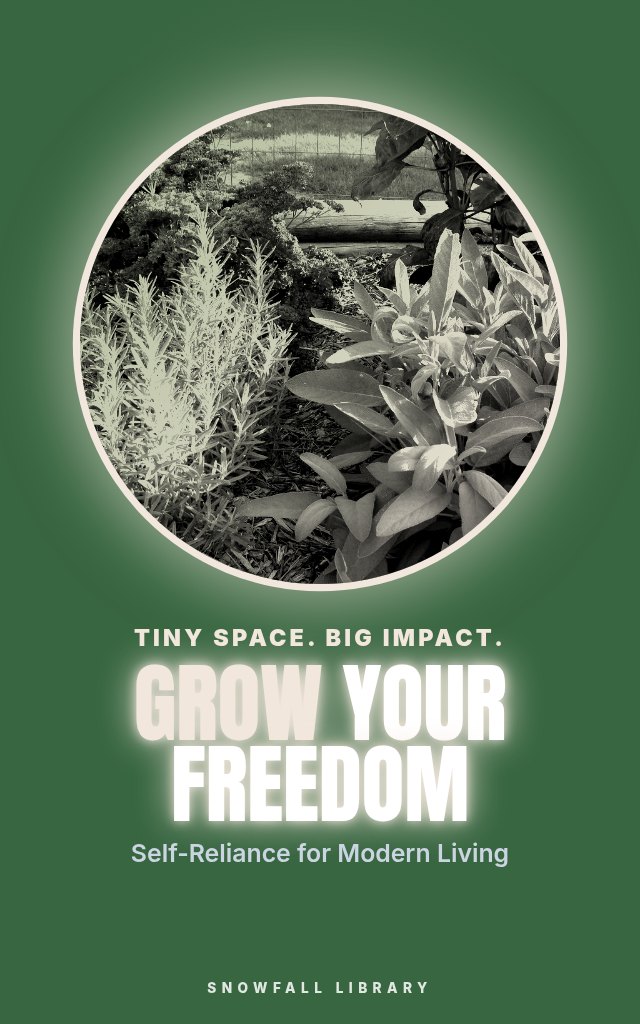
Grow Your Freedom: Micro-Homesteading for Renters and Small Spaces on a Tight Budget
Grow, forage, preserve and propagate food from an apartment or rental, with no land and very little money.
About this guide
- Renters and apartment dwellers with no land to work
- Budget-conscious people who assume self-reliance needs a farm
- Anyone who wants to lean less on the grocery store
- A self-reliance plan built around your actual space and resources
- Small-space growing methods, and crops that cope with limited sunlight
Product details
| Publisher | Snowfall Library (founded by Max) |
|---|---|
| Format | PDF Guide |
| Length | 20+ pages |
| Language | English |
| Delivery | Instant download after payment |
| Reads on | Phone, tablet, Kindle app or computer |
| Category | Gardening and Homesteading |
Better together
Add these to your order and save 35% on each one.
Book description
A windowsill, a balcony the size of a doormat and a lease that says no digging. That's the homestead most people actually have.
Grow Your Freedom works with it. Built around micro-homesteading on about a hundred dollars, it starts by taking stock of your space and resources and drawing up a plan that fits. Then come vertical, container and indoor growing for small spaces and low light, safe foraging for edible wild plants, and preserving by canning, fermenting, drying and freezing. You'll propagate plants from cuttings, seeds and divisions so you stop rebuying starts, and build a local network for sharing and bartering.
Who it's for
- Renters and apartment dwellers with no land to work
- Budget-conscious people who assume self-reliance needs a farm
- Anyone who wants to lean less on the grocery store
What you'll walk away with
- A self-reliance plan built around your actual space and resources
- Small-space growing methods, and crops that cope with limited sunlight
- Safety-first foraging skills and connections with local growers
- Preserving methods that stretch a harvest through the year
- Propagation know-how and a community to share, swap and barter with
The homestead you have is enough to begin.
What's inside
- Part 1: Foundations, Mindset & Assessment
- Part 2: Growing Food, Small Space Gardening
- Part 3: Foraging, Connecting With Local Abundance
- Part 4: Preservation, Extending the Harvest
- Part 5: Propagation, Multiplying Your Resources
- Part 6: Community & Bartering, Building a Support System
- Appendix: Resources & Next Steps
Look inside
Part 1: Foundations, Mindset & Assessment
You are standing in your kitchen. Maybe it is a galley kitchen with barely enough counter space for a toaster. Maybe your living room is also your office. You look at your grocery receipt, see the rising cost of fresh produce, and wonder how you ended up here. You want to be more self-reliant. You want to know where your food comes from and you want to stop feeling like your budget is at the mercy of global supply chains.
Then you search for homesteading advice. The results are discouraging. You see videos of people on five acres with goats, a tractor, and a sprawling orchard. You read articles about buying land, building greenhouses, and investing in high-end canning equipment. The message seems clear: homesteading is for property owners with deep pockets and endless time.
That message is wrong.
Homesteading is not a place. It is not a zip code, a specific square footage, or a collection of expensive tools. Homesteading is a set of behaviors. It is the practice of producing what you consume, preserving what you produce, and stewarding the resources you already possess. If you live in a studio apartment, a rental house, or a condo, you are not disqualified from this lifestyle. You are simply practicing it on a micro-scale.
The Land Requirement Myth
The most damaging misconception in the self-sufficiency movement is that you need land to be a homesteader. This idea keeps millions of capable, resourceful people from starting. They wait for the "someday" property, the "someday" budget, and the "someday" time. By the time they arrive, they have lost years of skill building.
Consider what actually makes a homestead functional. It is not the soil in the ground. It is the knowledge of how to turn a seed into a meal. It is the ability to recognize when a jar of pickles has fermented safely. It is the habit of mending a shirt instead of discarding it. These skills are portable. They work on a balcony, a fire escape, a windowsill, or a community garden plot.
When you remove the need for land, you remove the barrier to entry. You can start today with zero dollars, or, as this book suggests, you can start with a modest $100 to acquire the specific tools that provide the highest return on investment.
The Four Pillars of the Micro-Homestead
To redefine homesteading, we must look at the activities that actually matter. Whether you are on a thousand acres or in a high-rise, these four pillars remain the same.
- Production: This is the act of creating something from raw materials. In an apartment, this means growing herbs on a windowsill, sprouting seeds in a jar, or even just learning to bake bread from flour and water.
- Stewardship: This is the management of resources. It means preventing waste. It is the act of turning kitchen scraps into compost, or using the onion skins you usually throw away to make a vegetable stock.
- Economy: This is the financial aspect of self-reliance. It is not just about saving money, though that is a primary outcome. It is about understanding the value of your labor and reducing your dependence on external systems like grocery stores and delivery services.
- Community: This is the network. No person is an island. A true homestead relies on the exchange of goods, services, and knowledge with neighbors.
Example: You might think that growing a single tomato plant on your balcony is insignificant. However, if you learn to propagate that plant, save the seeds, and compost the spent vines, you have engaged in production, propagation, and waste management. You have completed the full cycle of a food system in three square feet.
The $100 Framework: Why Constraints Create Creativity
Why the $100 limit? It is a tool for your mindset. When you have a large budget, you solve problems ...
Readers also browse

Check Texts, Emails, Jobs and Stores Before You Pay

Identify, Cancel and Recover Payments You Didn't Expect

Start a Business With No Idea and No Money

A 30-Day Reset for Phone Habits and Focus