
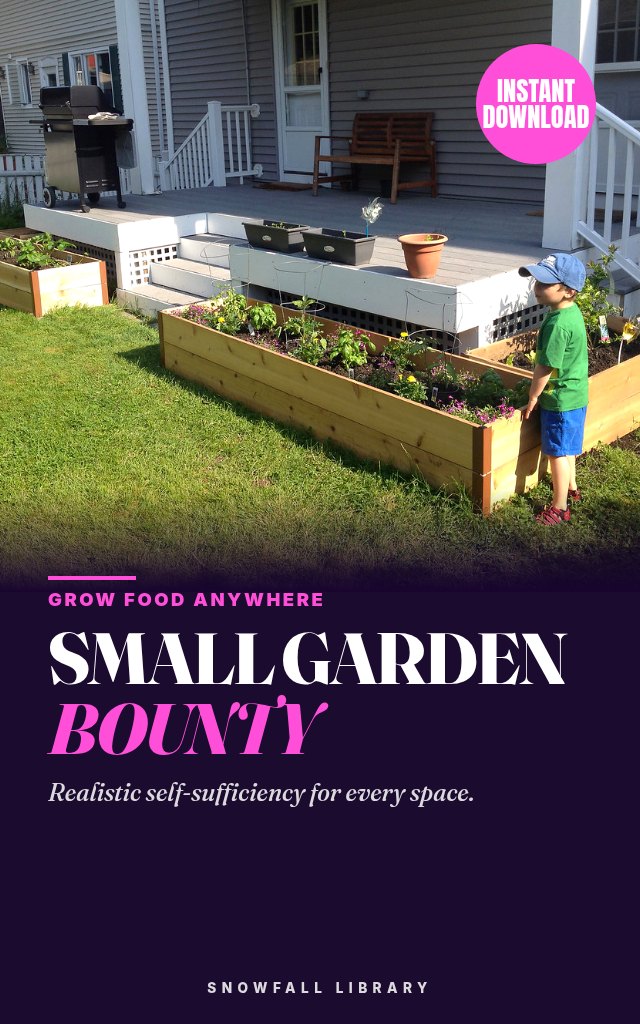
The Resilient Garden: Grow a Bounty of Food in Any Space
Grow a Year-Round Harvest in Any Size Garden
About this guide
- Suburban and urban gardeners with limited space, balconies, patios, small yards.
- Beginners eager to grow their own food, but unsure where to begin.
- Experienced gardeners wanting to maximize yield in a smaller footprint.
- Anyone seeking a more sustainable and reliable food source.
- A plan to assess your space, sunlight, and soil for optimal growing conditions.
Product details
| Publisher | Snowfall Library (founded by Max) |
|---|---|
| Format | PDF Guide |
| Length | 20+ pages |
| Language | English |
| Delivery | Instant download after payment |
| Reads on | Phone, tablet, Kindle app or computer |
| Category | Gardening & Homesteading |
Better together
Add these to your order and save 35% on each one.
Book description
Do you dream of fresh, homegrown food but feel limited by space or experience? Many want a garden, but worry it’s too complicated or time-consuming.
Who it's for
- Suburban and urban gardeners with limited space, balconies, patios, small yards.
- Beginners eager to grow their own food, but unsure where to begin.
- Experienced gardeners wanting to maximize yield in a smaller footprint.
- Anyone seeking a more sustainable and reliable food source.
What you’ll walk away with
- A plan to assess your space, sunlight, and soil for optimal growing conditions.
- Techniques for extending the growing season with succession planting and indoor gardening.
- Knowledge of high-yield crops perfect for small spaces, maximizing every inch.
- Practical sustainable practices, including composting and water conservation for a healthier planet.
- Solutions for common garden problems, ensuring a consistent year-round harvest.
What's inside
- Part 1: Laying the Foundation - Space, Sunlight & Soil
- Part 2: Core Crops & Techniques - Building Your Edible Landscape
- Part 3: Extending the Growing Season, Beyond the Traditional Limits
- Part 4: Advanced Techniques for Abundance, Sustainable Practices
- Part 5: Year-Round Harvest & Troubleshooting, Maintaining a Resilient Garden
Look inside
Part 1: Laying the Foundation - Space, Sunlight & Soil
Assessing Your Space & Sunlight: The Microclimate Map
Let’s be real. You’re probably not picturing rolling fields when you think about growing your own food. More likely, it’s a balcony, a patio, a small patch of yard squeezed between the house and the fence, or maybe even just a sunny windowsill. That’s okay! Plenty of delicious food can be grown in limited space. But before you even think about seeds, you need to understand what you’re working with. We're going to figure out exactly where the sun hits, how protected your space is, and what that means for what you can grow. This isn’t about transforming your yard into a perfect garden; it’s about making the most of what you’ve already got.
Why Map It Out?
Understanding your microclimate, the localized weather conditions in your specific growing area, is crucial. Even within a small space, sunlight, wind, and temperature can vary dramatically. Knowing these variations lets you choose the right plants for the right spots, maximizing your yields and minimizing frustration. Think of it as a little detective work that pays off big time with a more successful garden.
The Tools You’ll Need
Thankfully, this isn’t expensive. You’ll need:
- A printed or digital copy of the Microclimate Map template (available for download at [website address - placeholder]).
- A compass (a phone app works great).
- A notebook and pen, or a digital note-taking app.
- A way to mark your space, flags, tape, or even just rocks.
- About an hour, spread out over a day if possible.
Step 1: Define Your Growing Area
First, clearly define the area you intend to use for gardening. This could be the entire balcony, a specific section of the patio, or a designated bed in the yard. Be realistic. Start small; you can always expand later. Mark the boundaries of this area.
Action step: Physically outline your growing space. Use whatever works, string, chalk, tape, or even just visualize it if you're working with containers.
Step 2: Determine North
Using your compass, determine true north in your growing area. This is important because the sun’s path is dictated by its position relative to north. It’s easy to get confused with magnetic north on some compasses, so double-check your compass’s instructions. Mark north on your map.
Step 3: Observe the Sun's Path
This is the most important part. You need to track how the sun moves across your growing space throughout the day. It’s best to do this over several hours, ideally starting around 9 am and ending around 5 pm.
- Every hour, observe where the sun hits your growing area. Mark those areas on your map.
- Note the duration of sunlight each area receives. Is it direct, full sun (hot and bright)? Partial sun (sun for part of the day, filtered through something)? Or mostly shade? Use these classifications on your map:
- Full Sun (6+ hours): Ideal for tomatoes, peppers, cucumbers, and many herbs.
- Partial Sun (4-6 hours): Good for leafy greens, root vegetables, and some flowering herbs.
- Shade (Less than 4 hours): Best for certain leafy greens like lettuce and spinach, and some herbs like mint.
- Pay attention to shadows. Buildings, trees, fences, and even other plants can cast shadows. Note when and where these shadows fall on your growing area. This is especially important in the morning and late afternoon.
Pro tip: Don't rely on just one day’s observation. Cloud cover can significantly affect sunlight. Observe over several days to get a more accurate picture.
Step 4: Identify Microclimates Within Your Space
Now that you have a map of sunlight patterns, look for areas with distinct microclimates. These are small areas within your garden that have different conditions than the surrounding area. Consider these factors:
- Wind Exposure: Is your space sheltered from the wind, or ...
Readers also browse

Cheap, Healthy Weekly Meal Plans for Busy Households
Make Your Home Feel Cozy With Light, Texture and Scent
Engineer a Warm Off-Grid Cabin That Handles Real Winter
A Complete Guide to Home Food Preservation