
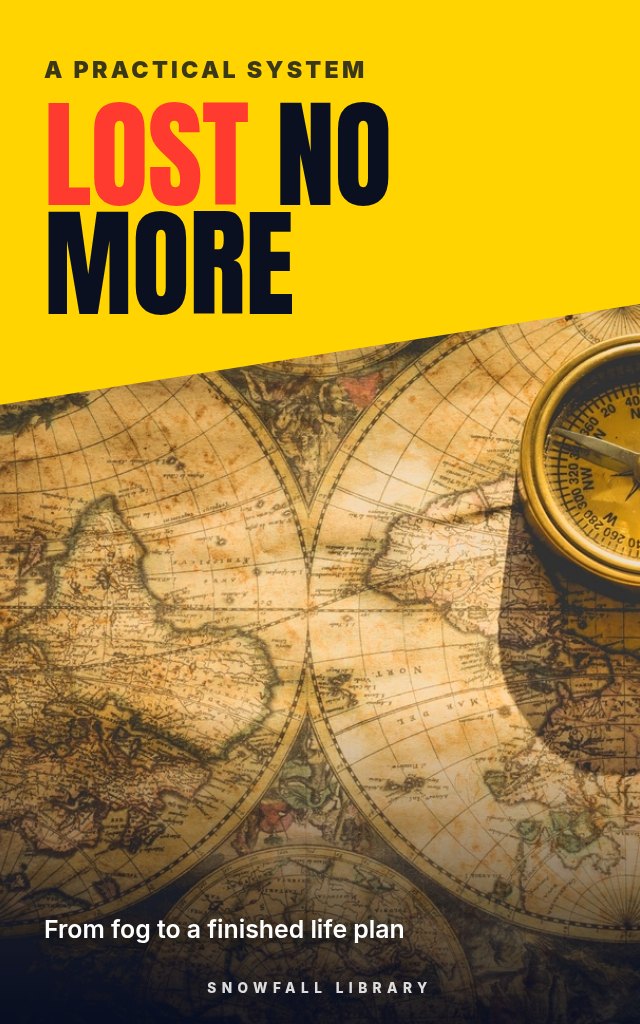
Lost No More: Find Your Direction and Finish a Real Life Plan
Scored self-inventory exercises and low-risk career experiments that end in a 90-day, 1-year and 5-year plan.
About this guide
- Students choosing a path after school
- Graduates drifting between jobs that don't feel right
- Early-career workers who fell into a field and want out, or a reason to stay
- Anyone at any age who keeps saying 'I feel lost' and wants to act on it
- A clear sense of why you've felt stuck, and why it isn't all down to you
Product details
| Publisher | Snowfall Library (founded by Max) |
|---|---|
| Format | PDF Guide |
| Length | 20+ pages |
| Language | English |
| Delivery | Instant download after payment |
| Reads on | Phone, tablet, Kindle app or computer |
| Category | Self-Improvement |
Better together
Add these to your order and save 35% on each one.
Book description
Everyone around you seems to have picked something. A course, a career, a city. You picked too, maybe, but by default, and now nothing quite fits. When someone asks what you want to do, the honest answer is 'I don't know, and that scares me.'
Lost No More treats that fog as a problem with causes, not a character flaw. It opens by explaining the systemic roots of feeling lost, then moves into a self-inventory with scored exercises, so you're working from evidence about yourself rather than vague passion-hunting. Next you generate options and test them with low-risk career experiments before committing to anything. Finally, you turn a decision into a written plan covering the next 90 days, the next year and the next five.
Who it's for
- Students choosing a path after school
- Graduates drifting between jobs that don't feel right
- Early-career workers who fell into a field and want out, or a reason to stay
- Anyone at any age who keeps saying 'I feel lost' and wants to act on it
What you'll walk away with
- A clear sense of why you've felt stuck, and why it isn't all down to you
- A scored self-inventory that shows you what you're working with
- A shortlist of options, each tested through a small real-world experiment
- A decision you can explain to yourself and to others
- A finished 90-day, 1-year and 5-year life plan
You reach the last page with a plan in hand.
What's inside
- Part 1, Why You Feel Lost: The Systemic Roots of Confusion
- Part 2, The Self-Inventory: Building a Foundation of Self-Knowledge
- Part 3, Generate & Test Options: From Exploration to Validation
- Part 4, Build Your Plan: From Decision to Action
Look inside
Part 1, Why You Feel Lost: The Systemic Roots of Confusion
It's 11:47 p.m. You're three tabs deep into "careers for people who don't know what they want," and every article says the same thing: follow your passion, find your purpose, listen to your heart. You close the laptop. The fear doesn't close with it.
Here's what nobody told you: that fear is not a character flaw. It's math.
You are being asked to make one of the highest-stakes decisions of your life with almost no reliable data about the two things the decision depends on: what you're actually like, and what the world of work actually contains. That's not a personal failure. That's an information problem. And information problems have a known solution: gather better data, structure it, decide, test, adjust. That's what this book does, step by step, with worksheets you score as you go.
Why "I don't know what to do with my life" is a rational statement
Think about what a good decision requires. To pick a direction, you need four categories of information:
- What you value (autonomy vs. security, money vs. meaning, stability vs. variety)
- What you can do (your actual, evidenced skills, not your self-image)
- What exists out there (real roles, real entry routes, real costs in time and money)
- What your constraints are (runway, location, obligations, credentials)
Now be honest: how many of those four can you fill in right now with specifics? Not vibes. Specifics.
Most people who feel lost can confidently answer zero of the four. Some can answer one. Almost nobody under 40 who hasn't deliberately investigated can answer all four. Meanwhile, the number of options has exploded. Your grandparents chose between maybe a dozen realistic paths, most of them visible in their own town. You're choosing among thousands of roles, most of which you've never seen up close, many of which didn't exist ten years ago, filtered through social media highlights that make everyone else's path look deliberate.
A brain asked to pick one option from thousands, with missing data on every input, will do exactly what yours is doing: freeze, then feel ashamed about freezing. The freeze is the system working correctly. The shame is the bug.
Action step: Right now, before reading further, write down your honest answer to each of the four categories above in two sentences each. Don't edit. This is your baseline. You'll retake it at the end of the book and the difference will be your proof of progress.
The two missing datasets
Let's name the gap precisely, because "gather more information" is useless advice without knowing which information.
Dataset 1: You (the internal map). Most people's self-knowledge is a collection of other people's opinions: a teacher who said you were "good with words," a parent who said you were "not a math person," a performance review that said you "need to be more proactive." These are weather reports from other people's climates. What you need instead is evidence: what you've actually done, when you've lost track of time, which tasks leave you drained at 3 p.m. and which leave you wired. Part 2 of this book builds that dataset through five scored inventories: values, skills, interests, personality/work style, and energy, plus a constraint ledger that maps your real starting position.
Dataset 2: The world (the external map). Ask a lost 24-year-old to name jobs and you'll get: doctor, lawyer, teacher, engineer, marketing, "something in tech." That's like walking into a library of ten million books and browsing a shelf of six. The actual landscape includes roles like implementation specialist, UX researcher, revenue operations analyst, forensic accountant, clinical data manager, and thousands more, each with a known entry route, price in time and money, and day-to-day reality. Part 3 teaches you to map this landscape and then, critically, to test pieces of it with cheap two-week experiments instead of betting years on a guess.
Here's the reframe ...
Readers also browse

Check Texts, Emails, Jobs and Stores Before You Pay

Identify, Cancel and Recover Payments You Didn't Expect

Start a Business With No Idea and No Money

A 30-Day Reset for Phone Habits and Focus