
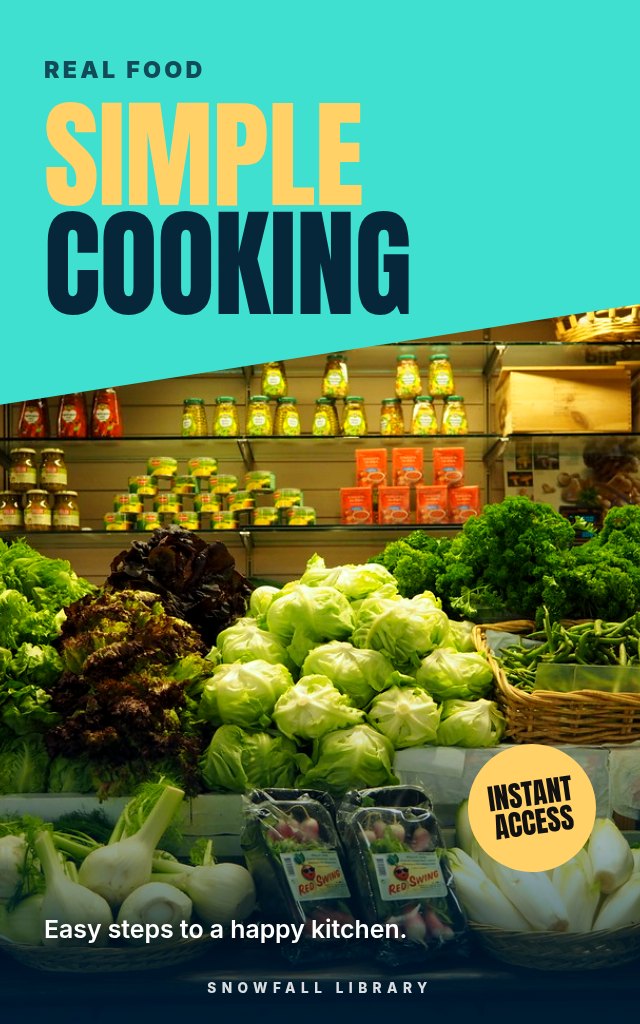
Kitchen Confidence: Real Food
From overwhelmed to enjoying easy, healthy meals at home
About this guide
- Busy professionals and parents who want to eat healthier without spending hours cooking.
- Anyone who feels intimidated by recipes and wants to gain confidence.
- Home cooks hoping to understand the principles behind good cooking, not just follow instructions.
- People who want to reduce mealtime stress and actually enjoy being in the kitchen.
- Efficient knife skills that speed up prep and make cooking safer.
Product details
| Publisher | Snowfall Library (founded by Max) |
|---|---|
| Format | PDF Guide |
| Length | 20+ pages |
| Language | English |
| Delivery | Instant download after payment |
| Reads on | Phone, tablet, Kindle app or computer |
| Category | Cooking |
Better together
Add these to your order and save 35% on each one.
Book description
Do you find yourself relying on takeout or pre-packaged meals, wishing you felt more comfortable in the kitchen? This guide is for you.
Who it's for
- Busy professionals and parents who want to eat healthier without spending hours cooking.
- Anyone who feels intimidated by recipes and wants to gain confidence.
- Home cooks hoping to understand the principles behind good cooking, not just follow instructions.
- People who want to reduce mealtime stress and actually enjoy being in the kitchen.
What you’ll gain
- Efficient knife skills that speed up prep and make cooking safer.
- A solid understanding of heat and how it affects your food, allowing you to adapt recipes and experiment.
- The ability to build delicious flavors using simple sauces and seasonings, making every meal taste special.
- Core recipes you can easily customize with what you have on hand, reducing food waste.
- Practical meal planning and prep strategies to save time and reduce weeknight chaos, so you can relax and enjoy your food. You’ll also learn to troubleshoot common cooking mistakes and create dishes you truly enjoy.
What's inside
- Chapter 1: Reclaiming Your Kitchen, The Foundation for Confidence
- Chapter 2: Knife Skills, The Cornerstone of Efficiency
- Chapter 3: Understanding Heat, The Engine of Cooking
- Chapter 4: Building Flavor, The Art of Sauces and Seasoning
- Chapter 5: Master Recipes, Versatile Building Blocks
- Chapter 6: One-Pan Wonders, Minimizing Effort, Maximizing Flavor
- Chapter 7: Troubleshooting & Adaptation, When Things Go Wrong
- Chapter 8: Expanding Your Repertoire, Beyond the Basics
- Chapter 9: Meal Planning & Prep, Saving Time and Reducing Stress
Look inside
Chapter 1: Reclaiming Your Kitchen, The Foundation for Confidence
Welcome to Your New Kitchen
Let’s be honest. Your kitchen probably isn’t the serene, inspiring space you see on cooking shows. It’s likely a bit… chaotic. Maybe it’s overflowing with gadgets you never use, mismatched containers, or food that’s past its prime. You’re busy. Life happens. And sometimes, the kitchen becomes a dumping ground. That’s okay. This isn’t about achieving Instagram perfection. It’s about creating a functional space that supports you in getting good food on the table, not stresses you out. A calm kitchen leads to calmer cooking, and that’s where confidence begins. We’ll start by resetting things, making it a place you actually want to be.
Assessing the Situation: The 15-Minute Scan
Before you start tossing things, let's get a clear picture of what we’re working with. This isn’t about judgment, just observation. Grab a notepad and spend 15 minutes doing a quick scan.
- Counter Space: How much usable counter space do you actually have? Be realistic.
- Cabinet/Drawer Inventory: Open three cabinets and one drawer. What’s in there? Be specific. (e.g., “Cabinet 1: Mugs, glasses, chipped plates”; “Drawer: Random utensils, rubber bands, takeout menus”).
- Pantry/Food Storage: What’s lurking in your pantry and fridge? What’s expired? What have you forgotten about?
- Tool Chaos: Where are your most-used tools? Are they easily accessible, or buried?
- Wish List: What one thing, if added, would make your kitchen immediately more functional? (A shelf? A better knife? A trash can?)
This quick assessment will give you a baseline. You don’t need a full remodel, just a realistic understanding of your starting point.
The Great Declutter: The 20/20 Rule
Now for the fun part (or the slightly daunting part, depending on your perspective). Decluttering isn’t about deprivation, it’s about intentionality. We’re making room for the things you actually use and enjoy.
The 20/20 Rule is your friend here: If you can replace an item for under $20 in under 20 minutes, get rid of it. Seriously. That specialty melon baller you used once? Gone. The chipped mug you’re keeping “just in case”? Gone.
Here’s a breakdown by area:
- Countertops: Clear everything except the absolute essentials (maybe a coffee maker, a fruit bowl). Everything else needs a home.
- Cabinets/Drawers: Be ruthless.
- Duplicates: Keep your favorite version of an item, donate the rest. Do you really need three whisks?
- Broken/Damaged: Toss it. Don’t hold onto things you’ll “fix someday.”
- Unused Gadgets: If you haven’t used it in six months, it’s probably time to let it go.
- Mismatched Containers: Donate or recycle. Invest in a small set of nesting containers instead.
- Pantry/Fridge:
- Expired Items: Check dates and discard anything past its prime.
- Forgotten Items: Be honest. If you bought it six months ago and haven’t used it, you probably won’t.
- Half-Empty Bags/Boxes: Combine similar items to save space.
Action step: Schedule 30 minutes, put on some music, and tackle one cabinet or drawer. Don’t try to do it all at once. Small wins build momentum.
Organizing for Efficiency: Zones and Accessibility
Decluttering is only half the battle. Now we need to organize what’s left in a way that makes sense. Think about how you cook, not how you think you should cook.
Create Zones: Divide your kitchen into zones based on activity:
- Cooking Zone: Stove, oven, microwave, frequently used pots and pans, utensils.
- Prep Zone: Counter space for chopping, mixing, and measuring. Knives, cutting boards, mixing bowls.
- Cleaning Zone: Sink, dishwasher, cleaning supplies.
- Storage Zone: Pantry, refrigerator, cabinets for dry goods and less frequently used items.
Accessibility is Key:
- Frequently Used Items: Store them within arm’s reach. Pots, pans, utensils, spices, the things you use every day should be easy to grab. * Less Frequently Used Items: Store them higher up or in the back of cabinets. Holiday dishes, specialty appliances, they don’t ...
Readers also browse
Cheap, Healthy Weekly Meal Plans for Busy Households

Make Your Home Feel Cozy With Light, Texture and Scent

Engineer a Warm Off-Grid Cabin That Handles Real Winter
Grow a Bounty of Food in Any Space