
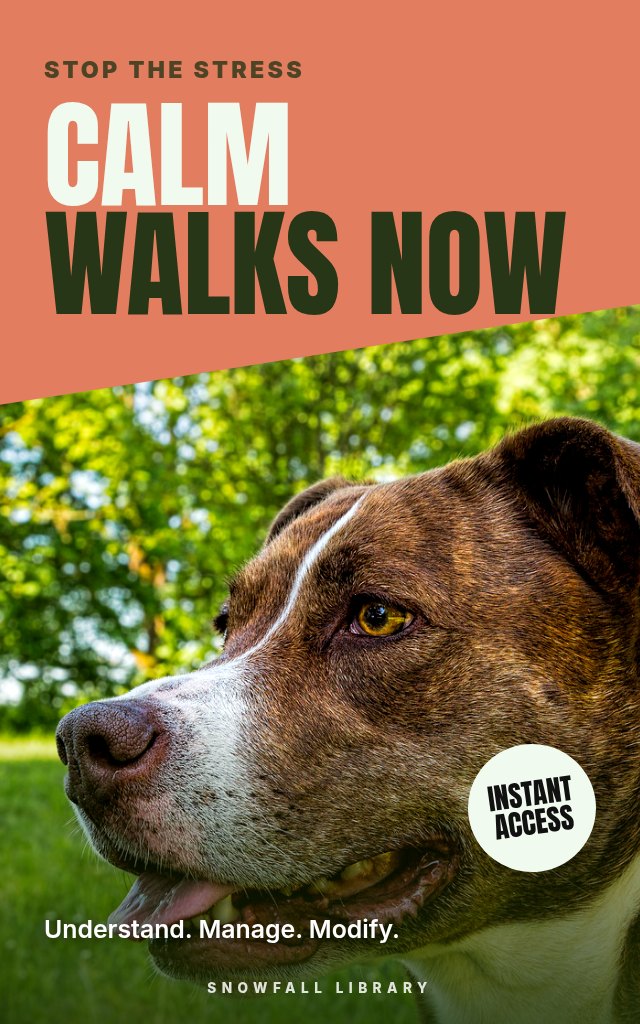
Reactive Dog: Peaceful Leash Walks
Understand why your dog reacts and build a calmer, happier life together
About this guide
- Dog owners whose dogs react on leash to other dogs, people, cars, or everyday sights.
- Owners feeling overwhelmed or embarrassed by their dog's behavior.
- Those who have tried basic training with limited success and want a deeper understanding.
- People seeking positive, effective methods for long-term improvement.
- The ability to recognize your dog’s specific triggers and the emotions driving them.
Product details
| Publisher | Snowfall Library (founded by Max) |
|---|---|
| Format | PDF Guide |
| Length | 20+ pages |
| Language | English |
| Delivery | Instant download after payment |
| Reads on | Phone, tablet, Kindle app or computer |
| Category | Pets |
Better together
Add these to your order and save 35% on each one.
Book description
Do walks feel more stressful than relaxing? Is your dog’s barking, lunging, or fear holding you back from enjoying time outdoors? This guide looks beyond simple symptom management, helping you understand the reasons behind reactivity for lasting change.
Who it’s for
- Dog owners whose dogs react on leash to other dogs, people, cars, or everyday sights.
- Owners feeling overwhelmed or embarrassed by their dog's behavior.
- Those who have tried basic training with limited success and want a deeper understanding.
- People seeking positive, effective methods for long-term improvement.
What you’ll walk away with
- The ability to recognize your dog’s specific triggers and the emotions driving them.
- A practical plan for creating safe, predictable walks for both of you.
- Techniques to gradually shift your dog's emotional response to triggers.
- Solutions for common challenges and how to adjust your training as needed.
- Guidance on when to seek support from a qualified professional.
What's inside
- Understanding Reactivity: The Foundation for Change
- Management: Creating a Safe & Predictable Environment
- Modification Techniques: Changing Emotional Responses
- Troubleshooting: Addressing Common Challenges
- Advanced Topics & Ongoing Support
Look inside
Understanding Reactivity: The Foundation for Change
What Is Reactivity? Defining the Behavior and Dispelling Myths
If you’re reading this, chances are walks with your dog are…challenging. Perhaps “stressful” or “exhausting” feel more accurate. Maybe you avoid certain streets, cross the road when you see another dog approaching, or feel a knot of anxiety tighten in your chest whenever your dog spots a trigger, another dog, a person, a car, even a bicycle. You’ve likely tried basic obedience, but those skills seem to disappear the moment your dog reacts. You’re not alone. Reactivity is surprisingly common, and understanding exactly what it is, and what it isn’t, is the crucial first step toward calmer, more enjoyable walks.
Defining Reactivity: Beyond “Bad Behavior”
Reactivity isn’t a diagnosis. It’s an umbrella term describing an overreaction to environmental stimuli. These reactions can manifest as barking, lunging, growling, whining, excessive leash pulling, or even attempts to hide or escape. Importantly, these behaviors aren’t necessarily about aggression, though aggression can sometimes be present. Reactivity is fundamentally about a dog’s emotional state and their inability to cope with something in their environment. It’s a communication, often born from fear, frustration, or a combination of both.
Action step: Spend five minutes observing your dog. What specifically triggers a reaction? Write down a list. This is your starting point.
Think of it this way: imagine someone jumps out and startles you. Your initial response might be to flinch, yell, or step back. That’s a reaction. Now, imagine that same person repeatedly approaches you, ignoring your attempts to indicate you need space. Your reaction will likely escalate, perhaps becoming defensive. That escalation, driven by mounting frustration and anxiety, is similar to what happens with a reactive dog.
Reactivity vs. Aggression: Knowing the Difference
It’s easy to assume reactivity is aggression, but they aren’t the same thing. Aggression is behavior intended to cause harm. While a reactive dog might display aggressive behaviors (like snapping or biting), the underlying motivation isn't necessarily to inflict injury. Often, the behavior is an attempt to increase distance from the perceived threat, a defensive strategy.
Here's a quick breakdown:
| Feature | Reactivity | Aggression |
|---|---|---|
| Motivation | Fear, frustration, anxiety | Intention to harm, control resources |
| Body Language | Often includes appeasement signals | Often includes stiff posture, direct stare |
| Outcome | Attempts to increase distance, escape | Potential for physical harm |
| Predictability | Often predictable triggers | Can be less predictable |
Warning: If your dog has already bitten someone or displays predatory aggression, this book is not a substitute for professional help from a certified applied animal behaviorist (CAAB) or veterinary behaviorist (DACVB).
Understanding Thresholds: The Point of No Return
A crucial concept in understanding reactivity is the idea of a “threshold.” Your dog has a distance from a trigger at which they can remain calm and under control. As the trigger gets closer, their anxiety rises. The threshold is that point where anxiety crosses over into reaction. Below the threshold, your dog might notice the trigger but remain relatively calm. Above the threshold, they react.
Imagine a volume dial. At low volume, you can barely hear the music. As you turn it up, the music becomes noticeable, then pleasant, then loud, and eventually overwhelming. Your dog’s anxiety works similarly.
Action step: Identify your dog’s threshold for a specific trigger. Start at a distance where your dog notices the trigger but doesn’t react. Slowly decrease the distance, observing your dog’s body language. The moment you see a tension response, you’ve likely reached the threshold. This distance is crucial information for training.
The “Fight, Flight, Freeze, Fawn” Response
When faced with a perceived threat, dogs (and humans!) activate their survival mechanisms. These manifest as the four Fs:
- Fight: Confronting the threat directly (growling, snapping, biting). * Flight: Attempting to escape the threat (pulling away, hiding). * Freeze: Becoming immobile, hoping ...
Readers also browse
Understanding and Resolving Problem Behaviors with Kindness and Science
Understanding and Healing Your Dog's Anxiety

Stop reacting, start understanding. Build a loving relationship with your toddler by meeting their needs with calm and empathy.
Reactive Dogs