
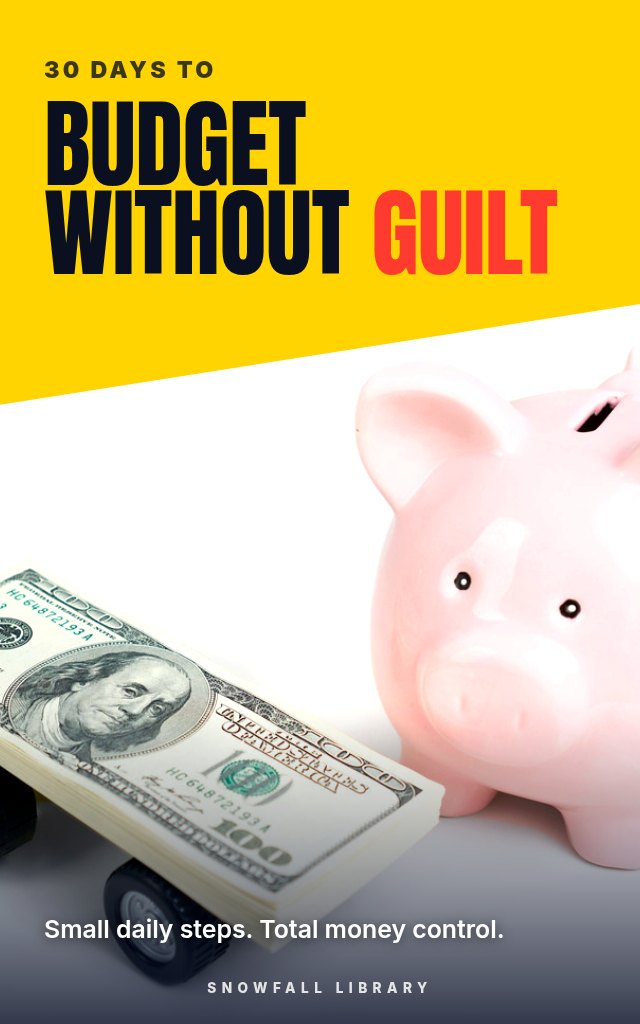
Budget Without Guilt: A 30-Day Money Plan Built on Small Daily Habits
Small daily actions that build a budget around how you actually think about money, not the other way round.
About this guide
- Complete beginners who honestly don't know where their money goes each month
- Anyone who's started a budget before and dropped it within a few weeks
- People who want control of their spending without cutting out every treat
- Readers who'd rather have plain language than financial jargon
- A clear picture of your money story: why past budgets failed and what sets off your spending
Product details
| Publisher | Snowfall Library (founded by Max) |
|---|---|
| Format | PDF Guide |
| Length | 20+ pages |
| Language | English |
| Delivery | Instant download after payment |
| Reads on | Phone, tablet, Kindle app or computer |
| Category | Personal Finance |
Better together
Add these to your order and save 35% on each one.
Book description
It's the third week of the month. The budget you set up with such good intentions has quietly stopped being opened, a few unplanned dinners have blown through the grocery line, and you're back to not wanting to look at your balance.
That isn't a math problem. It's a habit problem, and most budgeting books skip right past it. Budget Without Guilt starts with a Budget Personality quiz, then builds your plan around the result over 30 days of small, doable actions. No deprivation. No giving up coffee to prove a point. No guilt spiral when something unexpected comes up.
Who it's for
- Complete beginners who honestly don't know where their money goes each month
- Anyone who's started a budget before and dropped it within a few weeks
- People who want control of their spending without cutting out every treat
- Readers who'd rather have plain language than financial jargon
What you'll walk away with
- A clear picture of your money story: why past budgets failed and what sets off your spending
- A beginner-friendly budget that matches your real income and real life, set up in week two
- Automated bills and savings, so the system keeps running without daily willpower
- A way to adjust your budget for surprises, setbacks and celebrations instead of abandoning it
- A calmer, steadier relationship with your bank balance
One small step a day. By the end of the month, you'll have a budget built to bend instead of snap.
What's inside
- Part 1, Week 1: Understanding Your Money Story (Days 1-7)
- Part 2, Week 2: Building Your Budget Foundation (Days 8-14)
- Part 3, Week 3: Making It Automatic (Days 15-21)
- Part 4, Week 4 and Beyond: Maintaining Momentum & Adapting to Life (Days 22-30)
Look inside
Part 1, Week 1: Understanding Your Money Story (Days 1-7)
Day 1: Why Every Budget You've Tried Has Failed (It's Not Willpower)
Let’s be real. You’re here because other budgets haven’t worked. You probably feel a little (or a lot) stressed just thinking about money. Maybe you open your banking app and quickly scroll past the balances. Maybe you have a vague idea of where your money goes, but when you try to track it, you give up after a week. Maybe you’ve tried all the apps, all the spreadsheets, all the advice…and ended up exactly where you started.
It’s not you. It’s not a lack of willpower. It’s that most budgeting advice ignores why we spend the way we do. We’re not robots. We’re humans with history, feelings, and a whole lot of ingrained habits. Today, we're going to figure out what those habits are and why they've sabotaged you in the past.
The Willpower Myth
We’re told budgeting is about discipline. About saying “no” to everything fun. About tracking every penny. That’s exhausting! And frankly, unsustainable. Willpower is a finite resource. You have a limited amount each day. Trying to force a rigid budget on top of a life already filled with demands? Your willpower will crumble faster than a stale cookie.
Think about it: you start strong on January 1st, meticulously logging every coffee, every snack, every impulse purchase. By January 8th, you're already feeling deprived. By January 15th, you’ve thrown in the towel and ordered takeout three nights in a row.
This isn’t a failure of character. It’s a failure of system. We need a system that works with your brain, not against it.
Three Psychological Traps
Most budgets fail because they fall into one of these three traps:
- All-or-Nothing Thinking: This is the “perfect budget” trap. You believe if you deviate even slightly from the plan, the whole thing is ruined. One unplanned coffee becomes a justification for an entire shopping spree. You’ve “blown it” for the month, so why bother trying?
Example: You planned to spend $50 on groceries. You went over by $10. Instead of acknowledging it as a small overage, you think, “Well, I already messed up, might as well get pizza too.”
- Shame Spirals: Money and shame are often linked. We feel guilty about our spending, especially if it doesn’t align with what we think we should be doing. This shame leads to avoidance. We avoid looking at our accounts, avoid planning, and avoid dealing with the problem altogether. The avoidance just makes things worse, creating a vicious cycle.
Example: You spend more than you intended on clothes. Instead of analyzing why (maybe you were stressed and shopping was a coping mechanism), you beat yourself up about being “irresponsible” and vow to never buy anything nice again (which is also unrealistic).
- Vague Goals: “Save more money” is a terrible goal. It’s abstract, undefined, and doesn’t motivate action. What does “more” even mean? Without specific, measurable goals, you’re adrift.
Example: You want to “get out of debt.” That’s great, but it’s not a plan. A better goal is: “Pay an extra $50 towards my credit card debt each month.”
Your Budget Failure Autopsy
Before we build a new budget, we need to understand what went wrong with the old ones. This isn’t about dwelling on the past. It’s about learning from it. We’re going to do a “budget failure autopsy.” Grab a piece of paper or open a document on your computer.
Here’s what we’ll cover:
- List 2-3 budgets or budgeting attempts you’ve made in the past. (Apps, spreadsheets, envelopes, whatever you tried.) 2. For each attempt, answer these questions: * What was your biggest frustration? * What caused you to stop using it? * Which of the three psychological traps (all-or-nothing thinking, shame spirals, vague goals) played the biggest role in its failure? Be honest! * What one thing could you have done ...
Readers also browse

Check Texts, Emails, Jobs and Stores Before You Pay

Identify, Cancel and Recover Payments You Didn't Expect

Start a Business With No Idea and No Money

A 30-Day Reset for Phone Habits and Focus